What’s Behind the NDA? Posey County, Charlestown, and a Big Week for Southern Indiana’s Data Center Question
By Evan Plainman for Unite The Divided
On Tuesday, at a public meeting in Mount Vernon, Posey County Commission President Bill Collins confirmed what residents in red shirts had been asking about for weeks: the commissioners have signed a non-disclosure agreement with a company interested in building a data center here.
“We did sign an NDA with a development company,” Collins said. “I don’t even know… we have nothing brought in front of us yet.”
That’s the collision in one quote. Something is being planned for Posey County land, water, and power. The people it would affect are not allowed to know what, or by whom. This is the week it stopped being a national story and became a county one.
What we know
Here’s the verified record, with sources at the bottom.
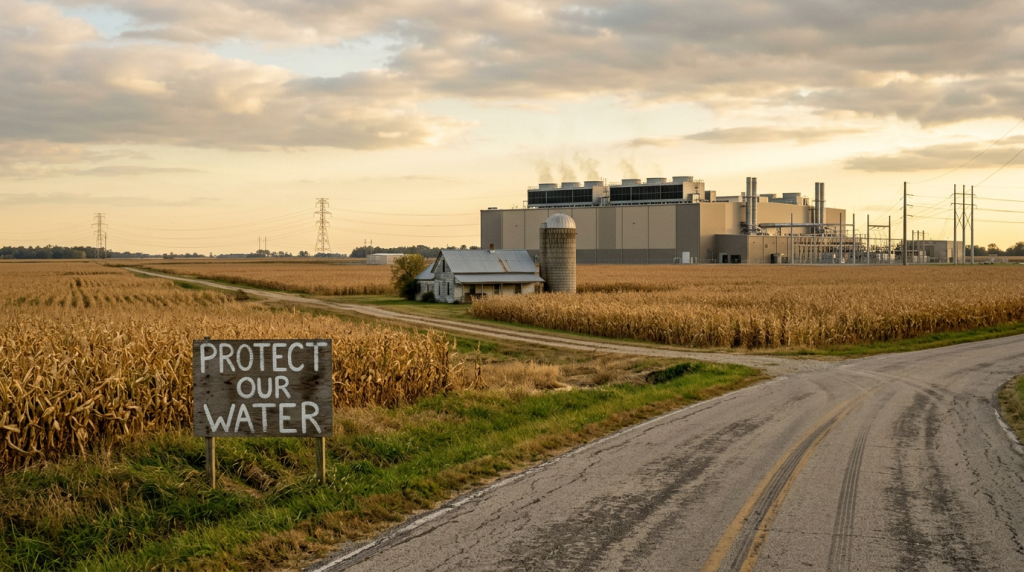
Posey County. The commissioners signed an NDA with a development company they have declined to name, citing the agreement itself. Collins says NDAs are routine for companies scouting sites, that no formal application has been filed, and that nothing passes without community input. Residents have packed meetings since June, many wearing red “Protect Posey County” shirts. At this week’s meeting, Wadesville resident Penny Padget, a certified geologist, asked whether monitoring wells would be required to track the aquifer: “If the wells go dry it’s too late, the aquifer’s been depleted.” The Area Plan Commission is drafting data center amendments to the county’s development ordinance, covering things like facility size classes and setbacks. Some residents want a moratorium until the rules are done; commissioners have said they’d rather finish the ordinance quickly than pause.
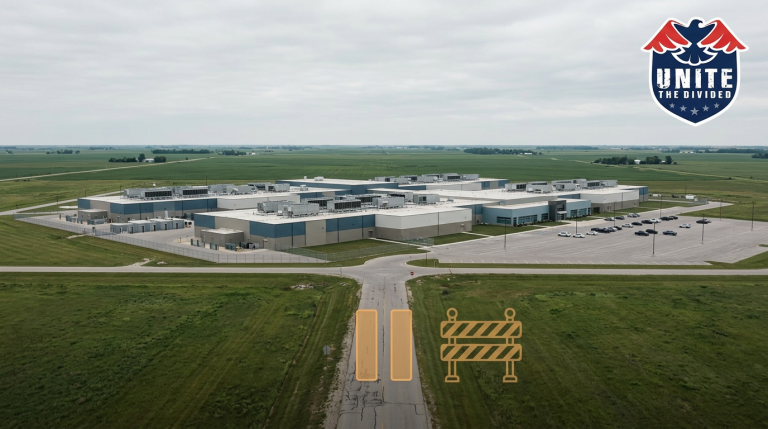
Charlestown, in Clark County. On Monday, July 20, the Charlestown Advisory Plan Commission voted 4-3 to advance a development plan from Tampa-based QLEVR LLC, working with ION Louis LLC: about 55,000 square feet on 12 acres in the Shadow Lake industrial park, roughly a $105 million investment, starting at 3 megawatts with up to 5 at full build-out. A petition against the project collected signatures numbering in the hundreds (600 delivered per the News and Tribune, more than 800 per Louisville Public Media, which is roughly one in ten Charlestown residents). Approval came with written stipulations: an environmental study, an electrical usage study, pre- and post-blast surveys, an eight-foot bermed tree screen, training for local emergency services, and a hard cap at the 55,000-square-foot footprint. Mayor Treva Hodges told the room, “My community is scared and my community is hurting,” and has since proposed a one-year moratorium on future data centers while this one is evaluated.
The wider map. By July, per data compiled by Indiana University’s Environmental Resilience Institute, 11 Indiana counties had passed data center ordinances, at least 17 had temporary moratoriums, and 2 had banned new data centers outright. Next door in Ohio, the state EPA announced July 21 it will not finalize a proposed statewide general permit that would have streamlined data center wastewater discharge into lakes and streams, after more than 7,000 public comments opposed it. And in northern Indiana, a settlement approved by state regulators requires Indiana Michigan Power’s largest data center customers, including Amazon, Google, and Microsoft, to make long-term commitments and pay their share of new generation and transmission, so existing ratepayers don’t quietly subsidize the build-out.
What’s claimed but unverified
This part matters as much as the record. Fence it off accordingly.
The identity of the Posey County developer is unknown. Any name you hear at the gas station or in a Facebook group is speculation until a document says otherwise. We’re working on it, the honest way.
The Charlestown developers made specific claims on the record: the facility won’t run artificial intelligence workloads, it will use a closed-loop cooling system that sharply cuts ongoing water use, and the company, not ratepayers, will pay for utility upgrades. Those are claims, made in a public hearing. They become facts when they show up in enforceable written commitments, and we could not yet confirm they have. Same for the job projections: an economic report cited about 200 construction jobs and 8 to 12 permanent positions growing to about 20 at an average wage near $76,000. Reports project; contracts commit.
Posey officials have referenced a handful of informal inquiries from other companies. We could not verify a count.
The bigger picture
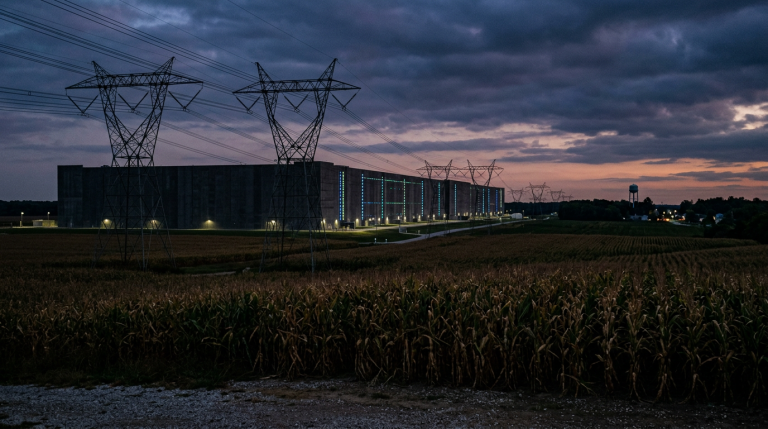
We’ve argued in this series that the cameras going up on poles and the data centers going up on farmland are two layers of one system: one layer collects information about ordinary people, the other processes it at a scale no county courthouse can see into. This week’s stories are about the processing layer arriving in Southern Indiana, and arriving the way it usually does: behind an NDA.
Bret Weinstein has a name for what that secrecy does to a community. He calls it the Cartesian Crisis: the growing difficulty of being sure of anything. When the county can’t say who the developer is, residents fill the gap with rumor, developers dismiss the rumors as misinformation, and pretty soon nobody in the room trusts anybody. Mayor Hodges saw exactly that in Charlestown, noting that misinformation spread online before the hearing, while her community’s underlying fear was real. Secrecy didn’t cause every part of that. It fed all of it.
Both narratives, named
The booster version: this is investment, jobs, and tax base; the facility is small and quiet; the company pays its own way; opposition is fear whipped up online. What that version omits: promises made at a podium bind nobody, the process was shaped by an NDA before the public heard a word, and nobody has said who monitors the water and the noise after the ribbon is cut.
The catastrophist version: the aquifer gets drained, bills spike, farmland disappears, and an AI complex moves in next door. What that version omits: Charlestown’s facility at full build-out would draw 5 megawatts, while the hyperscale campuses in the national headlines draw hundreds; closed-loop cooling, if delivered, does cut water use dramatically; the jobs and wages are real numbers; and Indiana communities now have working templates, 11 county ordinances and the I&M ratepayer settlement among them, for capturing benefits while limiting harm.
Both stories are convenient. Neither is the record.
Here’s my read
This part is opinion, labeled as such. The problem in Posey County isn’t data centers. It’s sequencing. The scouting, the land conversations, and the NDA all arrived before the county had an ordinance defining what a data center is. Charlestown, for all the shouting, got the order closer to right: a public hearing, a split vote, written stipulations, and a moratorium proposal for whatever comes next. Counties that write their rules first negotiate from strength. Counties that sign first negotiate from hope.
What you can do this week
Next hearings
- Posey County Area Plan Commission, special meeting: Monday, July 27, 5:30 p.m., Hovey House, 330 Walnut St., Mt. Vernon. Note the time: the county’s own web posting says 5:00 p.m., but the signed meeting notice (PDF) says 5:30. Go by the signed notice. This is the body drafting the data center ordinance. If you go, ask one specific question: will groundwater monitoring wells be required before and during operation?
- Charlestown: the moratorium discussion is expected at an upcoming meeting; a date had not been posted when this article went up. Agendas post at the City of Charlestown website.
If you can’t attend, you can still read the same documents we do: county meeting minutes, the posted agenda PDFs, and the stipulations attached to the Charlestown approval. When an official or a developer makes a promise, ask where it’s written down. That question, asked politely and often, is worth more than a hundred angry comments.
Seeing something in your county? A landman knocking on doors, a rezoning notice nobody can explain, an NDA rumor at the courthouse. Send it to our anonymous tip line at unitethedivided.com. We verify before we publish. That’s the whole point.
Error-correction note: The Charlestown facility (3 to 5 MW) is orders of magnitude smaller than hyperscale campuses, and conflating them misleads. Ohio’s EPA withdrew a proposed permit, not an active one. Petition counts in Charlestown vary by outlet; both figures are cited above. The Posey developer remains unidentified. Everything here is open to revision as better documents arrive. If we got something wrong, use the tip line for that too.
Correction, July 24, 2026: An earlier version of this article listed the Posey County APC special meeting at 5:00 p.m., matching the county’s web posting. The signed meeting notice, dated July 17, states 5:30 p.m. We have corrected the time above and linked the notice, since the county’s own website still shows the earlier time. If you show up at 5:00, you’ll simply be half an hour early.
Sources:
- Posey Commissioners Sign NDA with Data Center Developer (WNIN, July 22, 2026)
- Amidst data center concerns, Posey Co. commissioners reveal they’ve signed an NDA (14 News, July 21, 2026)
- Indiana residents wait hours in red shirts to say one thing: No data centers in Posey County (The Cool Down)
- Area Plan Commission Special Meeting notice, July 27, 2026, signed PDF (Posey County Government)
- Charlestown approves $105M data center despite strong community pushback (WDRB, July 2026)
- Charlestown board advances data center proposal with stipulations (Louisville Public Media, July 21, 2026)
- ‘Absolutely ridiculous’: Charlestown approves data center, with conditions (News and Tribune, July 2026)
- Nearly a third of Indiana counties have moved to restrict data centers (WFYI, July 6, 2026)
- Ohio EPA drops plan to permit data center discharges into lakes, rivers (WVXU, July 21, 2026)
- Ohio EPA rejects statewide data center water discharge permit after 7,000 public comments (WOWO)
- Ratepayer advocates hail ‘landmark’ settlement with data centers, utility company (Indiana Capital Chronicle, November 2024)
- Indiana regulators approve ‘large load’ interconnection rules (Utility Dive)