What AI Means for Southern Indiana Jobs (And Our Prediction, On the Record)
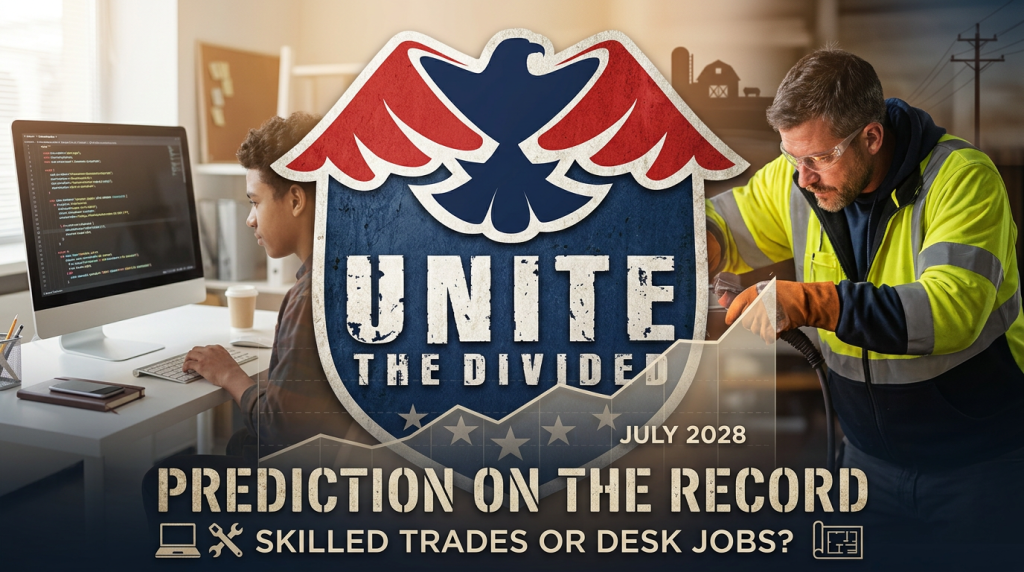
Everyone can feel it. AI is changing work, fast, and most of the conversation swings between two useless poles: “the robots are taking everything” and “relax, it is all hype.” Neither helps a family in Southern Indiana decide what to do. So let us do what we do here: look at the real numbers, say honestly what is known and unknown, and then do something almost nobody in media does. We will put a prediction on the record, with a date, and let reality grade us.
What the data actually shows right now
First, the honest baseline: overall unemployment has stayed fairly stable, around the low 4 percent range, and there is no mass AI wipeout in the headline numbers. Anyone telling you the sky has already fallen is wrong.
But underneath that calm surface, something unusual is happening at the bottom rung of the career ladder. Unemployment among recent college graduates has climbed to about 5.6 percent, notably higher than the overall rate. That inversion, where new graduates do worse than the workforce as a whole, is historically rare. Nearly 43 percent of recent grads are underemployed, working jobs that do not require their degree, the highest share since the pandemic. Entry-level job postings have fallen roughly 35 percent in about a year and a half. And a Stanford study found that workers aged 22 to 25 in the occupations most exposed to AI saw about a 16 percent relative decline in employment, with young software developers down nearly 20 percent from their 2024 peak.
Read that carefully, because the pattern matters: AI is not, so far, mass-firing experienced workers. It is quietly closing the entry door, the routine “grunt work” jobs that used to be how a 22-year-old got a start. Companies are absorbing that work with AI, and roughly 40 percent of CEOs say they plan to reduce junior roles.
The other side, honestly
Fairness requires the counter-evidence, and it is real. Employers actually project hiring for the class of 2026 to be up about 5.6 percent, and more graduates landed a role within three months this year than last. Some economists argue the entry-level squeeze is as much about the economic cycle as about AI, and that the panic outruns the proof. And here is the number that should reframe the whole conversation: about 30 percent of workers have essentially zero exposure to what current AI can do, because their work is physical and in-person. Mechanics, cooks, nurses, linemen, plumbers. Software cannot crawl into an attic.
The twist that matters most for us
The same AI boom that is squeezing desk-work entry jobs is creating a hiring surge in skilled trades, because someone has to build and power all of it. Demand for robotics technicians has roughly doubled in three years. Welders and electricians are up sharply. Data centers, the physical engine of AI, need electricians so badly that young tradesmen at some sites are reportedly earning over $240,000 a year without a degree. For a region like ours, with land, work ethic, and proximity to this build-out, that is not a threat. That is an opening.
Put plainly: the safest ground in the early AI economy looks like work that touches the physical world, work that requires human trust and judgment, and workers of any kind who learn to use AI as a tool rather than compete with it head-on. That matches what we argued in Is College Relevant? For Whom?: the assembly line to a generic desk job is exactly the path AI pressures most.
Our prediction, on the record
Talk is cheap, so here is our stake in the ground. This is a pre-registered prediction: we write it down now, we tell you exactly what would prove us wrong, and we will publicly grade ourselves on the review date, win or lose. If we are wrong, you will read that too.
Update log
We will post updates here at each review date, including if we are wrong.
What a Southern Indiana family can do now
No panic, no waiting. A few moves that make sense under almost any AI future: treat the trades as a first-class option, not a fallback, especially electrical, HVAC, and industrial maintenance, where the AI build-out is driving demand. If your kid is college-bound, favor fields where the degree is the actual credential and pair it with real work experience before graduation, because the entry rung is now the hard part. Whatever the path, learn to use AI tools directly, the advantage is going to people who drive the tools, not the people who ignore them. And build the human skills machines are worst at: showing up, judgment, communication, earning trust.
We will keep tracking this, with numbers instead of vibes, and we will grade our prediction in public. If you see AI changing hiring at your workplace here in Southern Indiana, tell us. That local, on-the-ground truth is exactly what the national coverage is missing.