Potholes & Following the Money Behind What Gets Fixed
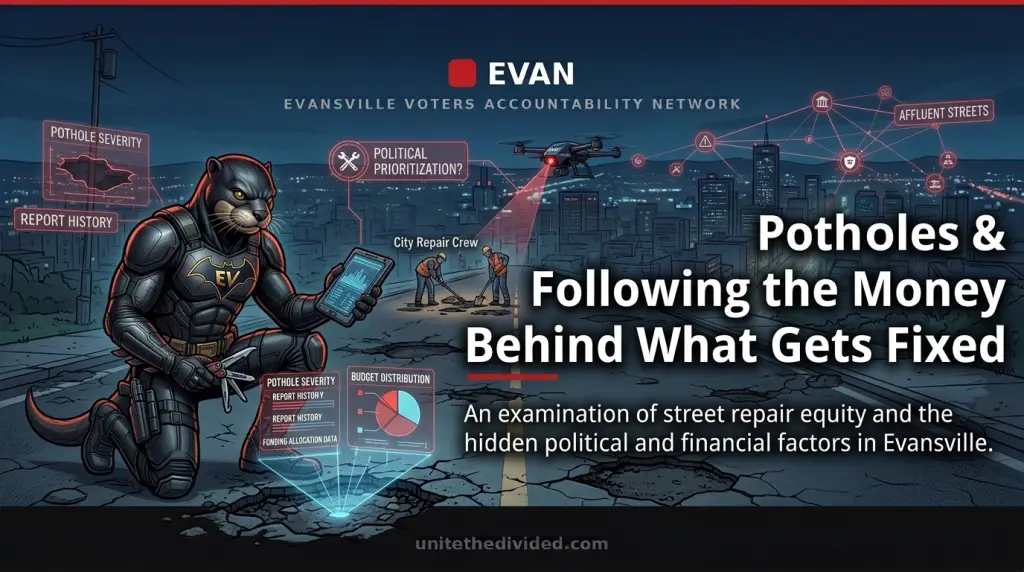
Roads, bridges, drainage, sidewalks, and sewers are the least glamorous things local government does, and the most universal. Everyone uses them, everyone notices when they fail, and almost no one sees how the decisions get made. Why does one street get repaved while another crumbles for years? Where does the road money actually come from, and where does it go? These are answerable questions, and the answers tell you a lot about how well your local government is really working.
This is about as non-partisan as an issue gets. A pothole does not care how you vote. Wanting roads that are safe and money that is spent wisely is something nearly everyone in Southern Indiana agrees on. That shared ground is exactly what EVAN is built to stand on.
Why this matters here
Infrastructure is funded by a patchwork most residents never see: local budgets, gas tax revenue, state programs and matching grants, wheel taxes, bonds, and special assessments. That complexity is part of the problem, because when the money is hard to follow, it is hard to hold anyone accountable for how it is prioritized. Meanwhile the need almost always outpaces the budget, so the real story is in the choices: which projects get funded first, who decides, and whether the process is fair and transparent or driven by who has the most influence. Deferred maintenance also has a hidden cost, because a road left too long does not just stay bad, it gets far more expensive to fix later.
Both sides, fairly
Local officials often face a genuinely hard job here, and it is fair to say so. There is rarely enough money to do everything, costs and weather are unpredictable, and every choice to fund one project means telling another neighborhood to wait. Officials will point to real constraints, limited revenue, rising material and labor costs, and long state timelines. Residents, for their part, raise fair concerns: uneven quality across neighborhoods, projects that seem to follow influence rather than need, poor communication about timelines, and repairs that do not last. The goal is not to assume bad faith or to excuse poor results. It is to see the priorities and the spending clearly, and judge them on the facts.
What we are asking here
On any road or infrastructure decision, residents have the right to know:
- What is the full list of planned projects, and how were they prioritized?
- Where does the funding come from, and how much is available this year?
- Who makes the final call on which projects go first, and on what criteria?
- How much are we spending on new projects versus maintaining what we already have?
- Are contracts bid competitively, and who is winning them?
- When a project is delayed or over budget, what is the documented reason?
What you can do
These decisions run through your city council, county commissioners and council, and local public works and highway departments, so your voice can reach them directly. Watch their agendas and budget hearings, that is where priorities are actually set. File a public records request for the capital or road improvement plan, the project list, and relevant contracts. Our records request guide shows you how, and the accountability guide covers the deadlines they must meet. Bring specific questions to a meeting using our guide to speaking up, a resident who shows up with the project list in hand is hard to brush off. Then tell us what you find, with the documents attached, so the whole community can see where the money is going.
We are not here to say your local officials are doing a good job or a bad one on roads. We are here to put the priorities and the spending in the open, so the community can judge for itself and push for what it needs.