Our first guide showed you how to send a public records request. This one shows you what the government is legally required to do once you do, and how to hold them to it when they stall. In Indiana, the deadlines and duties are set by law, and knowing them is most of the battle. This is the enforcement half of the records series, and it is where most people give up simply because no one told them their rights.
Know the response clock
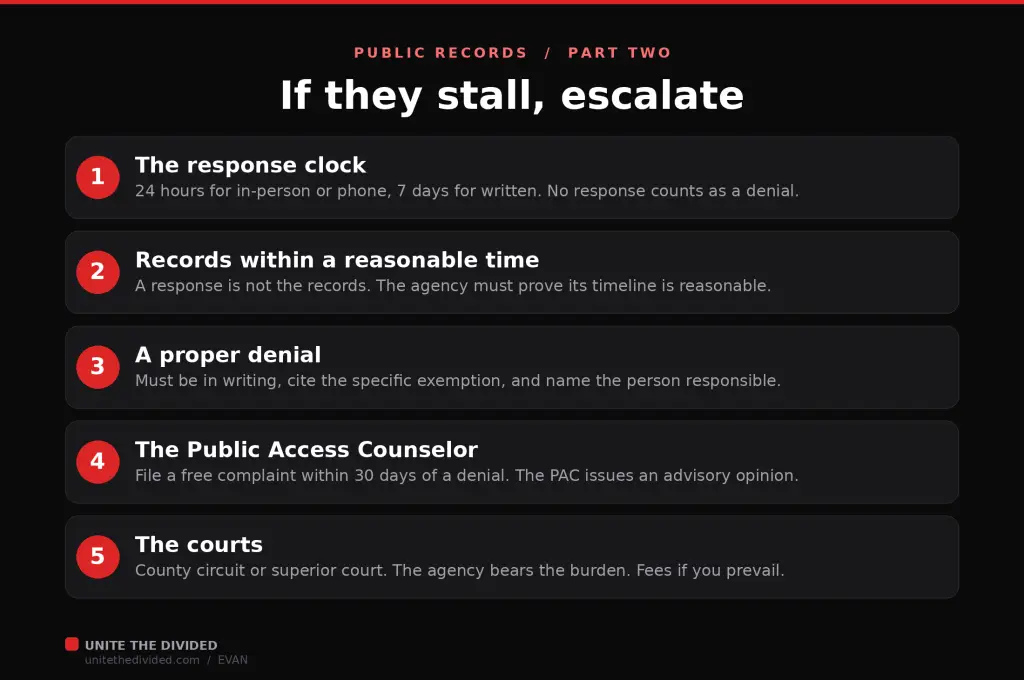
Indiana law sets a firm clock for the agency to respond, and it depends on how you sent your request. If you request in person or by phone, the agency must respond within 24 hours. If you request by mail, email, or fax, the agency must respond within 7 calendar days. This is set out in Indiana Code 5-14-3-9. If the agency does not respond within that window, the law treats the request as denied, which gives you the right to escalate.
A response is not the same as the records
Here is the detail that trips most people up. That 24 hour or 7 day clock is the deadline to respond, not the deadline to hand over the documents. A valid response can simply acknowledge your request and tell you when to expect the records. The law then requires the agency to produce the records within a reasonable period of time, which depends on the size and complexity of the request. The important part for you: the agency carries the burden of proving that its timeline is reasonable. Vague, endless delay is not reasonable, and a public access opinion has said so.
What a proper denial must include
If an agency denies your request, in whole or in part, the law does not let it simply say no. Under Indiana Code 5-14-3-9, a denial of a written request must be in writing, must cite the specific legal exemption it is relying on, and must include the name and title of the person responsible for the denial. If some of the record is exempt but the rest is not, the agency is supposed to redact the exempt part and release the rest. If you get a denial with no statute cited and no name attached, that itself is a problem you can raise.
What they can and cannot charge
Money is a common pressure point, so know the rules. Inspecting records in person is free. An agency cannot charge you just to look. For copies, the fees are capped by Indiana Code 5-14-3-8. State agencies use a uniform rate that does not exceed ten cents per page or the average cost, whichever is greater. Local agencies may charge the greater of ten cents per page for black and white, twenty five cents per page for color, or the actual cost of copying, and actual cost means paper and per page equipment cost only. It explicitly does not include labor or overhead. Certification of a document is capped at five dollars. Copies of law enforcement recordings, such as body camera footage, are capped by law. If an agency tries to charge you for staff time or a large “research fee,” that is a red flag worth challenging.
If they stall or refuse: the Public Access Counselor
Indiana has a dedicated office to help when access is denied: the Public Access Counselor, or PAC. If you believe a request was improperly denied or ignored, you can file a formal complaint, and it is free. You must file within 30 days of the denial. The PAC then forwards your complaint to the agency, gives the agency a chance to respond, and issues a written advisory opinion, generally within 30 days of the agency’s response. These opinions are advisory rather than binding, but they carry real weight, agencies pay attention to them, and going through the PAC first protects your ability to recover legal fees later if you end up in court.
If they still refuse: the courts
The final step is the courts, and Indiana law is built to make this reachable for ordinary citizens. You can file a civil action in the circuit or superior court of the county where the denial happened. The agency, not you, carries the burden of proving its denial was lawful. If you substantially prevail, the court can award your attorney’s fees, court costs, and litigation expenses, which is a strong protection, and it applies more readily if you went to the Public Access Counselor first. Civil penalties can also apply when an official knowingly or intentionally withholds a record they should have released.
How to hold the line, the EVAN way
The law works best when you build a clean record. Put your request in writing so the clock is documented. Be specific about what you want, which speeds everything up and removes excuses. Note the date you sent it and the date they responded. Keep every message. If a deadline passes or a denial looks improper, stay calm and escalate step by step: a polite follow up, then the Public Access Counselor, then, if needed, the courts. Accountability here comes from being organized and correct, not from being loud. When you win records that the community should see, share them with the source documents attached, so the facts speak for themselves.
Official sources
- Indiana Public Access Counselor, the state office for public access help, opinions, and the handbook.
- PAC formal complaint form, used to file a complaint under Indiana Code 5-14-5.
- The full Access to Public Records Act, Indiana Code 5-14-3, and the Open Door Law, Indiana Code 5-14-1.5, both available through the Public Access Counselor site and the Indiana General Assembly at iga.in.gov.
New here? Start with part one, How to File a Public Records Request, then come back to this guide to hold them accountable.
Note: this guide is general information, not legal advice. Laws and fees can change, so confirm current details with the official Public Access Counselor resources before you act.